Streaming device for TV: the best picks by key criteria
For viewers buying a streaming device for TV in 2026, the central question is not whether it can open Netflix, Disney+, Prime Video, or YouTube. All leading models can. The useful distinction is what happens after that: whether a platform keeps a large content library responsive, handles local media correctly, preserves premium audio formats, stays neutral between services, or makes a smart TV less dependent on its own aging software.
The strongest current choices remain Apple TV 4K, Google TV Streamer, Roku Ultra, Amazon Fire TV Stick 4K Max, Walmart’s Onn Google TV 4K Pro, and the unusually durable Nvidia Shield TV Pro. They are not interchangeable.
The home-theater decision: Nvidia Shield TV Pro versus Apple TV 4K
This remains the clearest split in the premium streaming box comparison. Apple TV 4K is the polished mainstream product; Nvidia Shield TV Pro is the specialist machine that survives because a specific part of the market still needs what newer hardware does not provide.
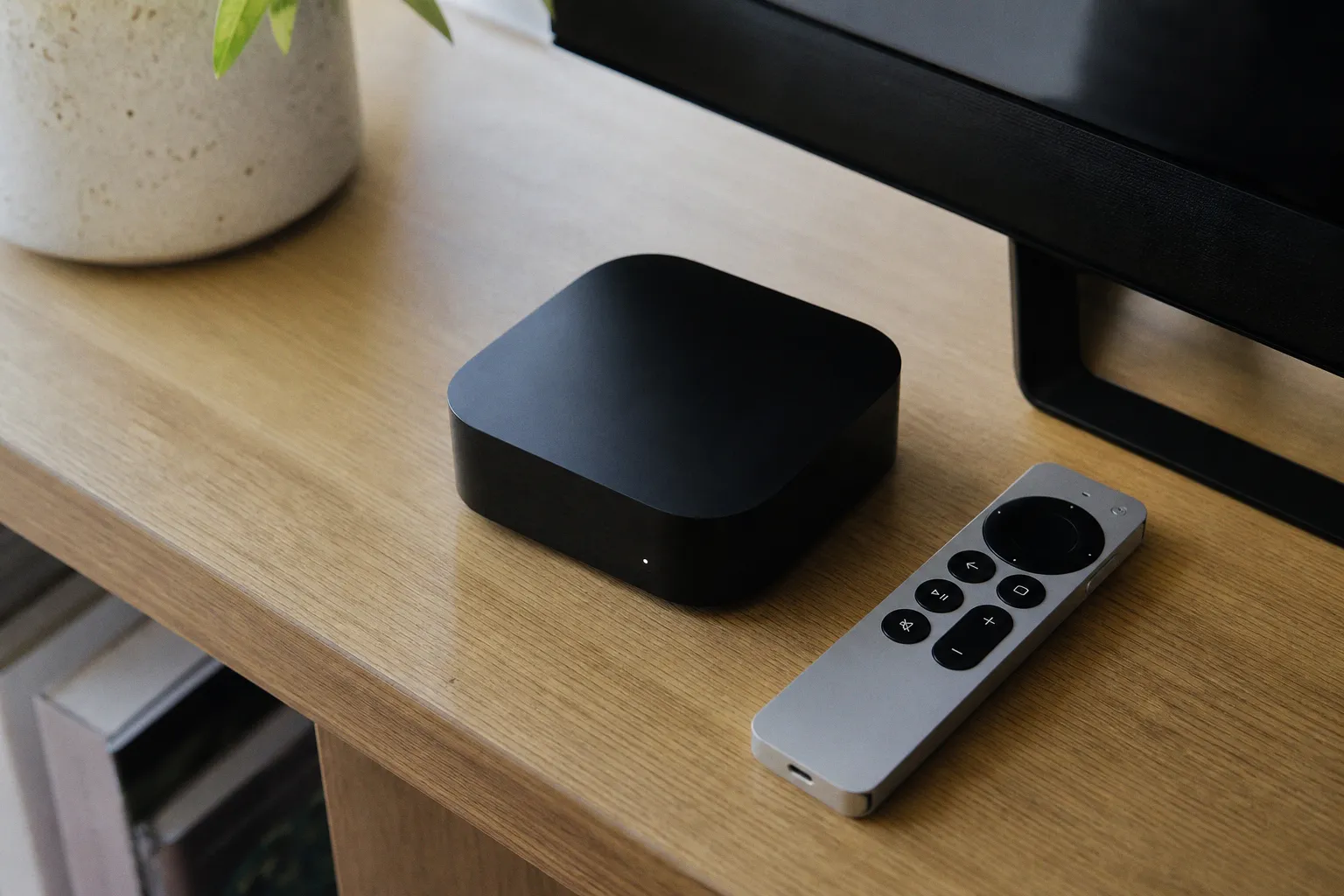
Apple’s third-generation Apple TV 4K, introduced in 2022, uses the A15 Bionic chip and is available with up to 128GB of storage. In ordinary streaming use, it is difficult to fault. Menus are fast, app switching is clean, Dolby Vision and HDR10+ are supported, and the interface is notably less committed to advertising its own retail agenda than most rival platforms. For households already using iPhones, AirPods, HomePods, or an Apple-centric media library, the integration is structural rather than decorative.
Its limitation is not speed. It is audio architecture.
Apple TV 4K does not offer native lossless audio passthrough for formats including Dolby TrueHD/Atmos and DTS-HD Master Audio. Those formats are converted to LPCM. That outcome can be perfectly acceptable for many soundbars and AV receivers, but it changes the proposition for viewers running a local Plex, Kodi, or Infuse library through an Atmos-capable receiver and expecting the original bitstream to arrive intact.
Nvidia Shield TV Pro, released in 2019, still occupies that territory. It supports passthrough for Dolby TrueHD/Atmos, DTS-HD Master Audio, and DTS:X, while also providing two USB 3.0 ports and AI-enhanced 4K upscaling. Its 16GB storage and 3GB RAM are no longer remarkable in isolation, but the device’s relevance has never rested on a benchmark chart. It rests on compatibility with a serious local-media setup.
There is a clear caveat. Nvidia ended official firmware updates for Shield TV Pro in June 2023. Google Play Services security patches and major streaming-app compatibility continue, but this is not a platform with an active product roadmap visible to consumers. Buying one in 2026 means choosing mature, specialized capability over the expectation of regular feature expansion.
| Parameter | Nvidia Shield TV Pro | Apple TV 4K (3rd Gen) |
|---|---|---|
| Best use case | Local media, AV receivers, enthusiast theater systems | Premium mainstream streaming and Apple ecosystem use |
| Storage | 16GB | Up to 128GB |
| Lossless audio passthrough | Dolby TrueHD/Atmos, DTS-HD MA, DTS:X | No; lossless formats are converted to LPCM |
| Local-media flexibility | Strong, including USB expansion | More controlled, app-led approach |
| Video support | AI-enhanced 4K upscaling | Dolby Vision and HDR10+ |
| Software position | Official Nvidia firmware ended in 2023 | Current Apple platform support |
| MSRP | $199 | $129 to $149 |
The better choice is therefore not subtle. Shield TV Pro is the best streaming player for a smart TV only when the television is part of a larger home-theater system and local files matter. It is excessive—and increasingly difficult to justify—for a household that watches only subscription apps and wants the simplest path to Dolby Vision streaming.
Apple TV 4K is the more defensible premium purchase for that broader audience. It behaves like an appliance rather than a content-sales surface. But that elegance should not be mistaken for universal technical superiority.
Apple TV 4K is the premium streaming default; Shield TV Pro remains the exception for viewers who treat audio passthrough as a requirement, not a line on a spec sheet.
Google TV Streamer turns the television into a household control point
Google’s September 2024 replacement for Chromecast changes the company’s pitch. The Google TV Streamer is not merely a 4K streaming device with a redesigned enclosure; at $99.99, it is positioned as a small smart-home hub that happens to sit beside the television.
Its hardware is more appropriate for that role than the older Chromecast generation. The unit includes 32GB of storage and 4GB of RAM, and it supports native Thread and Matter integration. That matters because the television increasingly serves as a shared household display: a place to view camera feeds, receive delivery alerts, check lights, and control connected devices without opening a phone.
Google TV’s underlying strength remains discovery across services. Its interface has long been built around recommendations and aggregation rather than a strict, app-by-app grid. This is useful for viewers whose watchlists move between subscription services, free ad-supported television, and on-demand rentals. It can also be intrusive for anyone who wants the home screen to behave like a neutral launcher.
The larger trade-off is that Google’s recommendation engine is an extension of its advertising and services business. The platform is designed to steer viewers through catalogs, not simply present them. That is increasingly normal across connected-TV operating systems, but it should be part of the purchase decision. A good interface is not necessarily a disinterested one.
Google TV Streamer is particularly well suited to three groups:
1. Google Home households. Native Thread and Matter support make the box more useful than a conventional streaming player when smart-home devices are already part of daily routines.
2. Viewers who search by show rather than by app. Google’s aggregation model reduces the need to remember which service carries a title, particularly as licensing arrangements and content libraries shift.
3. Owners of older smart TVs with deteriorating software. A separate Google TV device can restore a modern discovery layer without replacing a still-good display panel.
For viewers searching for current Hindi-language streaming options, the device’s cross-service search is particularly useful when paired with a current viewing shortlist such as this guide to the best Hindi web series to watch right now. The point is not that Google TV solves fragmented licensing; no platform can. It reduces the friction of finding where a title has landed.
The Google TV Streamer is not a home-theater substitute for Shield TV Pro, and it does not have Apple TV’s unusually restrained interface. It is the strongest middle-market option for viewers who want their streaming box to participate in the connected home rather than remain a dedicated video endpoint.
The value tier is no longer synonymous with compromise
The lower end of the market now contains two very different products: Walmart’s Onn Google TV 4K Pro and Amazon’s Fire TV Stick 4K Max. Both undercut the $99.99 Google TV Streamer, but they represent opposing theories about value.
Onn Google TV 4K Pro costs $49.88 and is difficult to ignore on raw specifications. It offers 32GB of storage, 3GB of RAM, hands-free voice control, and a built-in smart speaker. That is unusually substantial hardware for a sub-$50 device. It is not simply a basic HDMI stick; it is a small streaming box intended to remain visible and usable in the room.
The drawback is straightforward: the value proposition depends on comfort with Walmart’s retail positioning and Google TV’s recommendation-heavy operating system. For buyers who want a low-cost route into a capable Google TV environment, this is the more convincing value play than a stripped-down stick with minimal storage.
Amazon Fire TV Stick 4K Max, second generation, takes a different route. Released in 2023 with a $59.99 retail price, it has a quad-core 2.0GHz processor, 16GB of storage, and Wi-Fi 6E support. The form factor remains its major advantage. It disappears behind the television, travels easily, and gives a wall-mounted display or secondary-room set a capable 4K streaming interface without additional furniture clutter.
Fire TV’s limitation is not operational speed. It is the degree to which Amazon uses the home screen to promote Prime Video, rentals, channels, and advertising inventory. Prime Video is not merely an app on Fire TV; it is the commercial center of the platform. That may be convenient for Prime-heavy households. For viewers who subscribe broadly across competing services, it can make the interface feel like a sales channel before it feels like a library.
| Parameter | Onn Google TV 4K Pro | Fire TV Stick 4K Max |
|---|---|---|
| MSRP | $49.88 | $59.99 |
| Form factor | Compact streaming box | HDMI streaming stick |
| Storage | 32GB | 16GB |
| RAM | 3GB | Not specified in the available comparison data |
| Wireless | Not specified in the available comparison data | Wi-Fi 6E |
| Voice functions | Hands-free voice control and built-in speaker | Alexa-led Fire TV voice controls |
| Platform orientation | Google TV discovery and smart-home ecosystem | Amazon retail, Prime Video, and Alexa ecosystem |
What streaming device to buy at this price point depends less on processor differences than on where a household already spends its media time. Onn is the better answer for Google Home users and app-neutral viewers who want generous storage. Fire TV Stick 4K Max makes more sense for buyers who value Wi-Fi 6E, travel-friendly hardware, and Alexa integration—or who are already comfortable with Amazon’s increasingly commercial interface.
Neither should be chosen purely because it is inexpensive. A $50 device that creates daily annoyance through interface clutter is not actually cheap over several years of use.
Roku Ultra 2024 is the case for a television-first platform
Roku’s position has changed as the connected-TV business has become more aggressive about advertising, free channels, and owned content. The company still monetizes through platform advertising and distribution, but Roku’s user experience remains more legible than Amazon’s and less ecosystem-bound than Apple’s or Google’s.
The 2024 Roku Ultra costs $99.99 and brings a faster ARM Cortex-A55 processor, 2GB of RAM, Wi-Fi 6, and an updated Voice Remote Pro. The remote has backlit keys and USB-C charging, improvements that sound peripheral until the device has been used in a dark living room for several months. Remote quality remains one of Roku’s practical advantages: television control is still an activity conducted at arm’s length, often without a phone nearby.
Roku Ultra is not the specification leader. Its 2GB of RAM is modest beside Google TV Streamer’s 4GB, and it is not intended as a Thread or Matter control hub. It does something more commercially disciplined: it keeps attention on television.
That distinction matters for viewers who do not want the connected display to become an extension of a phone ecosystem or a smart-speaker strategy. Roku’s search and app model are simple enough for multi-user homes, including households where different generations expect the remote to work without account-management rituals.
Roku’s platform is especially effective in these scenarios:
- A shared family television. The interface is predictable, remote-led, and comparatively easy to navigate for viewers who do not want voice commands or deep personalization.
- A smart TV with poor built-in software. Roku Ultra can bypass a lagging television OS while preserving the display’s 4K HDR capabilities.
- A subscription mix that changes often. Roku is less tied to a single premium video service than Fire TV is to Prime Video or Apple TV hardware is to Apple’s broader ecosystem.
- Viewers who value remote design. Backlit buttons and USB-C charging address small but recurring frictions that cheaper streaming players leave unsolved.
There is a practical qualification for enthusiasts. Roku Ultra is not the correct choice for a local-library user who requires the Shield’s lossless audio path. Nor does it offer the Google TV Streamer’s native smart-home hub function. Its verdict rests on a narrower claim: it is one of the best streaming devices for TV when the television experience itself, rather than an adjacent ecosystem, is the priority.
Roku Ultra does not win the platform arms race. It wins by treating the remote, the app grid, and the next episode as the center of the product.
Hardware specifications only matter when they remove a real bottleneck
Streaming-device marketing tends to turn every specification into a buying trigger. Storage, RAM, Wi-Fi standards, HDR badges, and processor branding all appear consequential. Some are. Some only become relevant in edge cases.
Storage is one of the more tangible differentiators. Google TV Streamer and Onn Google TV 4K Pro each offer 32GB, while Fire TV Stick 4K Max and Nvidia Shield TV Pro provide 16GB. For a household using only a handful of large streaming services, 16GB can be sufficient. The problem emerges when the platform reserves a meaningful portion for system files, apps expand, cached data accumulates, and the device becomes a home for free-TV services, live-TV apps, game-streaming clients, and media tools. Storage does not make Netflix look better, but it can prevent a device from becoming administratively tedious.
Wireless standards require similar restraint. Wi-Fi 6E on Fire TV Stick 4K Max is useful only when the home network includes a compatible Wi-Fi 6E router and the television location can benefit from the additional spectrum. Roku Ultra’s Wi-Fi 6 support is also a real upgrade over older wireless hardware, but it will not fix poor router placement, dense walls, or a congested broadband connection.
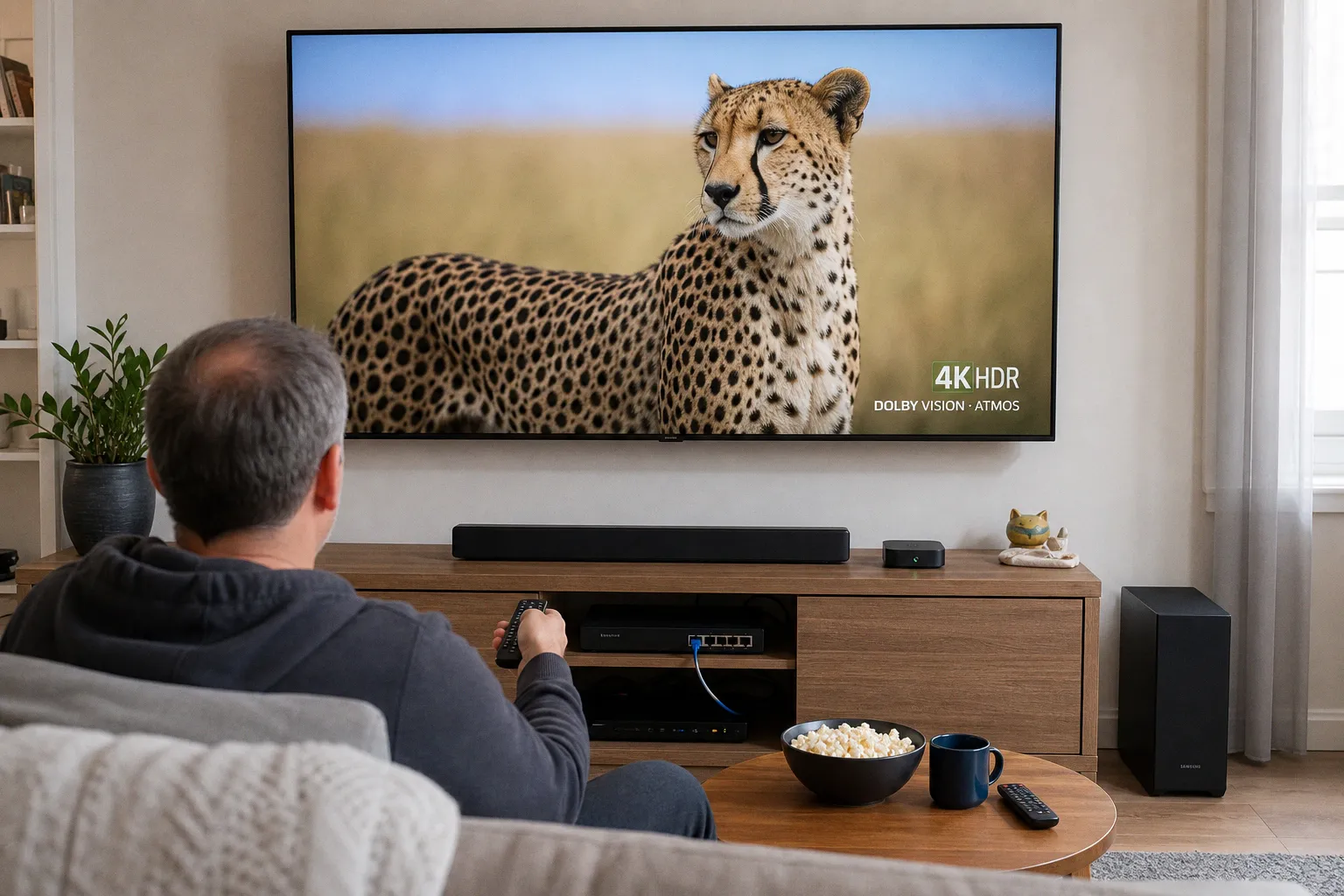
For stable high-bitrate streaming, wired Ethernet remains the cleaner solution where the device supports it and the home layout allows it. This is particularly relevant for 4K HDR playback, live sports streams, and home-theater users working with local media files. A premium television panel cannot compensate for a stream repeatedly collapsing into lower bitrate because the connection is unstable.
HDR logos also need context. Dolby Vision and HDR10+ support can improve compatible content on a capable television, but no streaming player creates contrast range that the television itself cannot display. A midrange LCD with limited local dimming will not become an OLED-class display because a new box supports another HDR format. The streaming device controls delivery and compatibility; the screen still determines much of the final image.
The same logic applies to AI upscaling. Nvidia’s implementation is valued because it can improve the perceived sharpness of lower-resolution material on a large 4K panel. Yet it is not a substitute for a clean source, appropriate bitrate, or a display with competent processing. It is a useful enhancement, not a rescue operation.
The operating system is the purchase, not the box
A streaming device for TV is often purchased to escape a television’s native operating system. That is sensible: smart-TV software ages faster than display hardware, and app support, speed, and interface design can deteriorate long before a 4K panel becomes obsolete.
But replacing the built-in system means selecting a new platform relationship.
Apple TV is the least advertising-forward environment in this group and the cleanest fit for Apple households. Google TV is strongest in discovery, cross-service recommendations, and smart-home interoperability. Roku is the most straightforward television-first choice. Fire TV delivers strong value and Amazon integration but carries the heaviest retail and Prime Video emphasis. Shield TV Pro is the technical outlier, optimized for users who care about local playback and lossless formats more than platform freshness.
The resulting choices are more disciplined than a universal ranking:
| Viewer priority | Best pick | Why |
|---|---|---|
| Straightforward premium streaming | Apple TV 4K | Fast A15 hardware, refined interface, Dolby Vision and HDR10+ |
| Lossless home-theater audio and local libraries | Nvidia Shield TV Pro | Full passthrough support for TrueHD/Atmos, DTS-HD MA, and DTS:X |
| Google Home and Matter/Thread integration | Google TV Streamer | 32GB storage, 4GB RAM, and native smart-home hub capability |
| Best low-cost Google TV hardware | Onn Google TV 4K Pro | $49.88 price, 32GB storage, hands-free control |
| Compact hardware with Wi-Fi 6E | Fire TV Stick 4K Max | Portable stick design, 16GB storage, Wi-Fi 6E |
| Remote-led, TV-first experience | Roku Ultra 2024 | Improved processor, Wi-Fi 6, and upgraded Voice Remote Pro |
The practical mistake is buying based on the content service that happens to be most visible on the home screen. Carriage disputes, rights reversions, sports-package moves, and the expansion of ad-supported tiers ensure that viewing habits will change. A device should make those changes easier to absorb, not lock a household deeper into one company’s promotional logic.
For most buyers, Roku Ultra, Google TV Streamer, and Apple TV 4K form the sensible premium shortlist. Roku is the better neutral television appliance; Google TV Streamer is the better connected-home device; Apple TV 4K is the best-finished choice for the Apple ecosystem.
Shield TV Pro remains the correct answer for a smaller but technically demanding audience. Fire TV Stick 4K Max and Onn Google TV 4K Pro prove that budget hardware can now be legitimately capable, provided the buyer accepts the platform strategy attached to it.
The television may be the largest screen in the room, but the streaming box increasingly determines what that screen feels like to use every night.
FAQ
Which streaming device is best for a home theater system with local media files?
Is the Apple TV 4K a good choice if I don't use other Apple products?
What are the main advantages of the Google TV Streamer?
Should I buy the Amazon Fire TV Stick 4K Max or the Onn Google TV 4K Pro?
Why would someone choose the Roku Ultra over other streaming devices?
 Streaming Devices & Smart TVsSelect a streaming player with Ethernet for 4K HDR
 Streaming Devices & Smart TVsGoogle TV streaming device: which model should you buy?
 Streaming Devices & Smart TVsPortable streaming devices: are they worth the money?
 Cable & BroadcastingSelect the best satellite TV provider for rural sports