Select the best satellite TV provider for rural sports
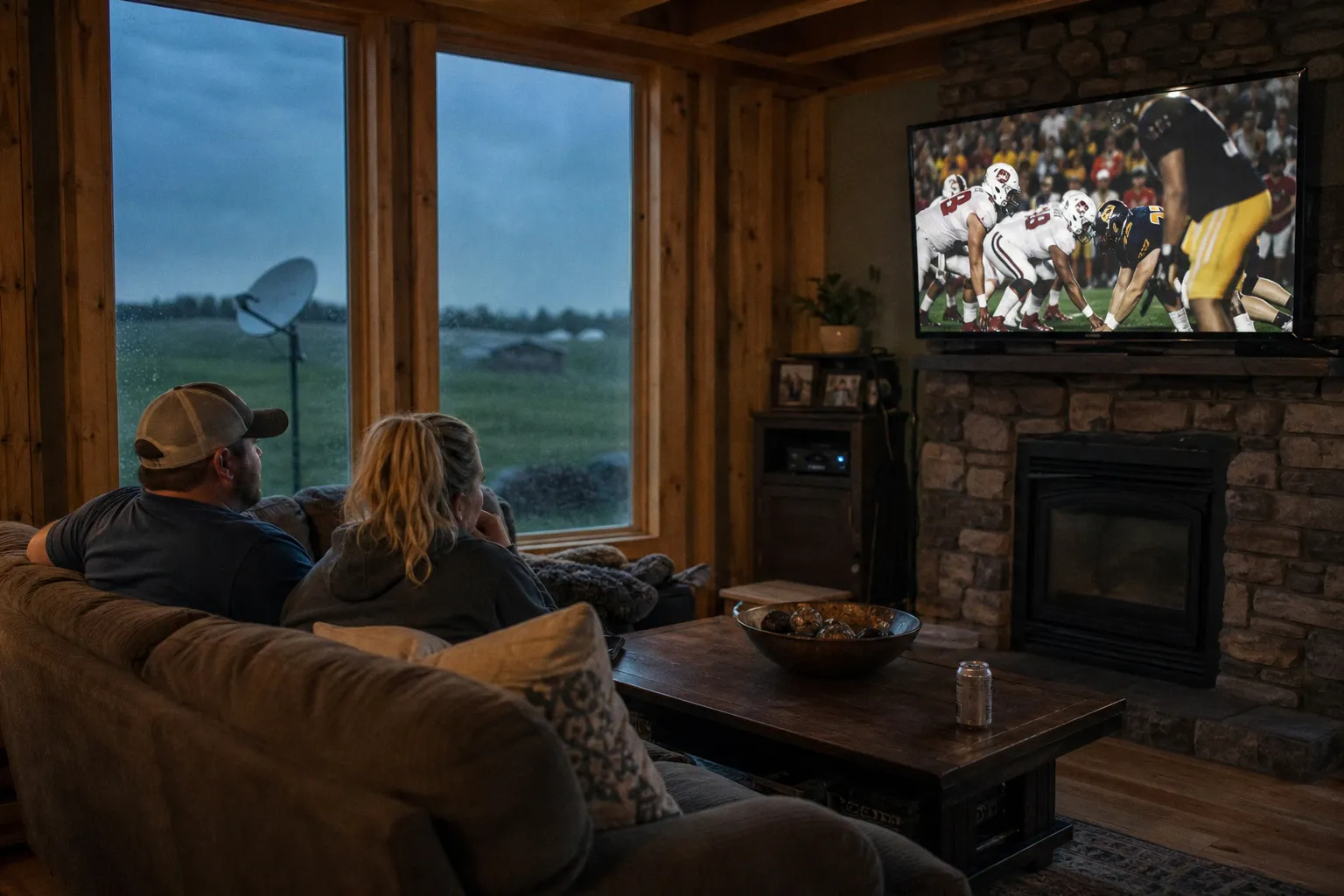
That is the real problem when people ask how to check select the best satellite TV provider for rural homes. The answer is not “which company has more channels.” Channel count is cheap marketing. The job is to verify three things before you sign: whether the dish can see the southern sky, whether your local teams are carried in your billing ZIP code, and whether the contract math still works after the promo price dies.
Satellite still has a job in rural America. For homes with weak broadband, bad cellular, and no practical cable option, it can be the only stable way to get ESPN, Fox, CBS, NBC, FS1, TNT, and the regional sports networks that carry regular-season games. But it is not magic. Heavy rain can still knock out a live feed. Carriage disputes can still remove a channel. And a 24-month contract can turn a “deal” into a slow leak.
I test TV hardware and cord-cutting setups with one bias: I do not care what the provider wants to sell. I care what survives a Sunday afternoon, a thunderstorm, and the second-year bill.
Start with the dish, not the channel lineup
Satellite TV begins with geometry. DIRECTV and DISH Network are the two primary satellite TV providers in the United States, and both need a clear view of the southern sky. That sounds simple until you put a dish on a rural property with pine trees, a ridge line, a metal barn, or a neighbor’s grain silo sitting in the wrong place.
If the installer cannot get clean line-of-sight, the best sports package in the country is irrelevant. You will get pixelation, dropouts, or no install at all.
Here is the blunt field check I use before I even look at package tiers:
1. Find the likely dish location before ordering.
Do not assume the roof is the answer. A pole mount in a field can beat a roof mount if it has a cleaner southern view and easier service access.
2. Check the southern sky at game time, not just at noon.
Tree shadows are not satellite signals, but they reveal the stuff that blocks the sky. A summer canopy can be very different from a winter view.
3. Ask about the cable run.
Long or ugly coax runs can create install compromises. If the dish has to sit far from the house, get the installer’s plan before approving the job.
4. Plan for weather exposure.
Rural installs take more abuse: wind, ice, loose mounts, livestock, falling limbs. A dish that is “technically installed” but mounted on a soft post is a future service call.
5. Do not accept vague signal assurances.
Providers often advertise high reliability, sometimes around the 99% mark. Fine. That number does not cancel physics. Heavy precipitation and thick cloud cover can still cause rain fade.
Rain fade is not a myth. It is the moment your signal drops because moisture interferes with the satellite transmission. Most of the time, it is temporary. For a live sports viewer, temporary is still expensive if it happens in the fourth quarter.
Satellite is reliable until weather, trees, and bad mounting remind you it is still a dish pointed at space.
The fix is not panic-buying a bigger package. The fix is redundancy. If you care about live sports, pair satellite with an over-the-air antenna where possible. More on that later.
Regional sports networks are the trap door
The dirtiest word in rural sports TV is not “blackout.” It is “available.”
A provider may carry a regional sports network. That does not mean it carries your regional sports network at your address. RSNs are tied to territories and billing ZIP codes. Two homes in the same state can get different team coverage. A farm twenty miles outside a metro area can land in a worse sports map than a house inside city limits.
This is where many buyers get burned. They see “regional sports included” in a Choice-tier or Ultimate-tier package and assume their baseball, basketball, or hockey team is covered. Then the first week of the season arrives and the channel is missing, blacked out, or parked in a higher tier.
When I evaluate a satellite provider for a rural sports household, I do not ask “Do you have sports?” I ask these questions in order:
- Which RSNs are available for this exact service ZIP code?
Not the nearest city. Not the county. The actual ZIP code attached to the account.
- Which teams are carried live on those RSNs?
RSN branding can be misleading. One network may carry one pro team but not another because rights are split by league or territory.
- Is the RSN in the base package, a mid-tier package, or a sports add-on?
This is where the bill jumps. A package that looks affordable can become ugly once the RSN fee and sports tier are added.
- Are there current carriage disputes?
Satellite providers and channel owners fight over fees. Viewers lose. If your must-have RSN is in a dispute window, I would not sign a long contract without a backup plan.
- Are national games enough for your household?
If you mainly watch NFL on broadcast networks and national college football, your needs are different from someone tracking 140 regular-season baseball games on an RSN.
The phrase “how to check select the best satellite tv provider for rural tv” is awkward, but the process is not: use the provider’s address lookup tool, confirm the RSN list in writing if possible, and compare that list against the actual schedule of the teams you watch. Do not rely on a generic channel lineup PDF. Those are sales brochures, not guarantees.
National sports are easier. Local teams are not.
National sports channels are usually more predictable. ESPN, FS1, NFL Network, NBA TV, MLB Network, NHL Network, TNT, TBS, CBS Sports Network, and conference channels tend to sit in known tiers. You still need to watch the package level, but the availability is less ZIP-code-sensitive than RSNs.
Local professional teams are where the pain lives. Baseball is the worst for many households because so much of the regular season sits on RSNs. NBA and NHL can be similar. NFL is simpler for many rural viewers because more games are on CBS, Fox, NBC, ESPN, and Prime Video, but local market rules still matter.
Here is the working comparison I use.
| Sports need | What matters most | Satellite risk | Backup worth considering |
|---|---|---|---|
| NFL Sundays | Local CBS/Fox, NBC, ESPN, NFL Network | Local affiliate disputes or missing locals in fringe areas | OTA antenna for CBS/Fox/NBC |
| MLB regular season | Correct RSN by ZIP code | RSN missing, blackouts, carriage fights | League streaming only helps if out-of-market |
| NBA/NHL local teams | RSN access and tier placement | RSN fee and package creep | OTA rarely solves most regular-season games |
| College football | ESPN, Fox, FS1, CBS, NBC, conference networks | Higher tier needed for conference channels | Streaming bundle if broadband is strong enough |
| Soccer | USA, Fox, FS1, ESPN, beIN in some cases | Add-on fragmentation | Streaming apps may carry key competitions |
The table is not pretty. It is useful. Sports rights are fragmented by design. Providers profit when you buy the next tier “just to be safe.”
DIRECTV vs. DISH: the real comparison for rural sports
I am not going to pretend this is a clean beauty contest. DIRECTV and DISH both solve the same rural problem: they deliver a big live-TV bundle where cable and fiber do not reach. Both generally require a clear southern sky. Both can suffer rain fade. Both can involve promotional pricing and long contract terms. Both can frustrate you when a channel owner and provider start fighting over fees.
The choice comes down to package fit, RSN access, hardware behavior, and total cost after month twelve.
| Factor | DIRECTV | DISH Network |
|---|---|---|
| Rural availability | Strong national satellite footprint, line-of-sight required | Strong national satellite footprint, line-of-sight required |
| Sports positioning | Often stronger for households that need broad sports tiers and RSN access, depending on ZIP code | Can be cost-effective, but RSN availability must be checked carefully |
| Contract reality | Promotional terms commonly run into 24-month commitments | Promotional terms commonly run into 24-month commitments |
| Weather weakness | Rain fade possible in heavy precipitation | Rain fade possible in heavy precipitation |
| Best first question | “Which RSNs do I get at this ZIP code, and in which package?” | “Which RSNs do I get at this ZIP code, and in which package?” |
| Biggest buyer mistake | Assuming a national sports package includes local team coverage | Assuming a lower monthly price includes the sports channels you actually watch |
That last row matters. Most bad satellite decisions are not caused by lack of research. They are caused by researching the wrong thing.
A 100+ channel entry package sounds fine if you watch general entertainment and national news. For sports, it may be a decoy. The channels that matter are usually higher up the ladder. Add RSN fees, DVR fees, extra receiver charges, and second-year pricing, and the cheap bundle starts gaining weight.
Channel count is a lousy metric. One missing RSN can make 150 channels feel like an empty box.
If you ask me which provider is “best,” I ask for your ZIP code and teams before I answer. Without that, any recommendation is theater.
The contract math: where the bill gets its teeth
Satellite promotions are built to look clean on day one. The real cost lives across the full term. A typical satellite TV promotion can involve a 24-month contract. The first-year price may be tolerable. The second-year price may not be. That is not a technical issue. That is accounting with a remote control.
Run the math like this before you sign:
1. Write down the month-one price.
Include the package, broadcast fees, RSN fees, DVR service, receiver fees, taxes, and sports add-ons. If the salesperson gives you a clean round number, assume it is incomplete until proven otherwise.
2. Write down the post-promo price.
Do not accept “it may change.” It will change. You need the range.
3. Multiply by the contract term.
A $25 monthly jump over the second year is $300. A $45 jump is $540. That can erase the difference between satellite and a streaming bundle.
4. Price the cancellation penalty.
Rural internet can improve. A local fiber co-op can arrive. A better fixed wireless plan can appear. If you are locked in, flexibility has a cost.
5. Add the cost of redundancy.
If you need an OTA antenna, a streaming device, or a backup sports app, include it. The real sports setup is often a stack, not one box.
This is where my slightly cynical side stops being a personality flaw and starts saving money. Marketing sells the first bill. You pay the full curve.
For rural sports households, the cheapest plan is not always the best plan. But the most expensive plan is often just fear priced as convenience. If you watch two teams and four channels carry 90% of those games, build around those channels. Do not buy the top tier because the grid looks comforting.
If you want a sanity break from provider spreadsheets, broader consumer coverage and practical life guides at Amajing World can be useful for stepping outside the TV-bundle tunnel for a minute. Then come back and finish the math. The bill will not do it for you.
Use ATSC 3.0 and an antenna as your free pressure valve
Satellite is not the only signal in the air. Over-the-air TV still matters, especially for sports. CBS, Fox, NBC, and ABC carry a lot of high-value live events: NFL, college football, major golf, NASCAR, Olympics coverage, and prime-time games depending on the season and rights package.
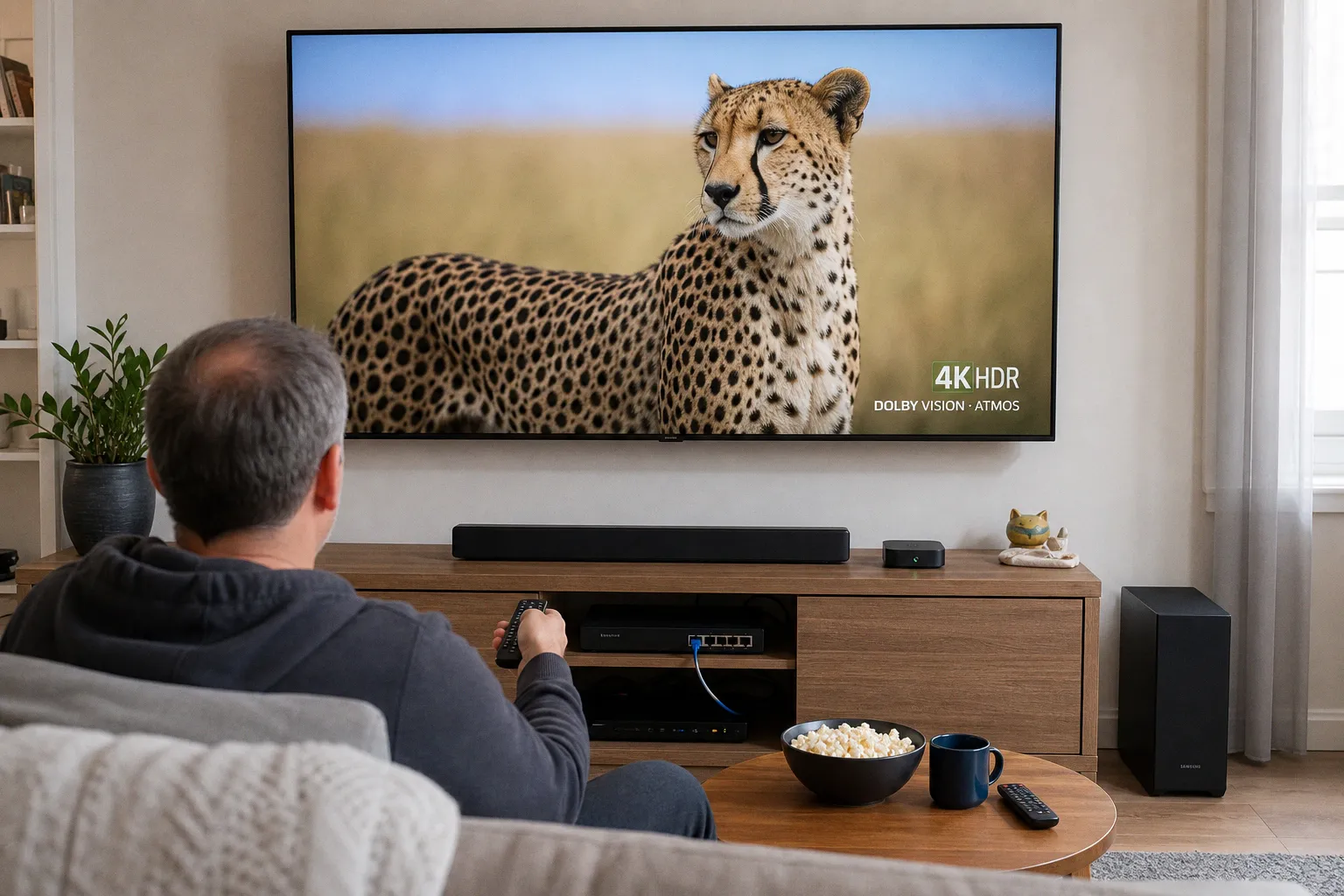
ATSC 3.0, also called NextGen TV, is being deployed across the United States. It supports up to 4K resolution and Dolby Atmos audio, though real-world broadcasts vary by market and station. The FCC has been working toward transition goals around 2027. That does not mean every rural home gets perfect 4K sports tomorrow. It means OTA is becoming more technically relevant, not less.
For rural viewers, an antenna can do three useful things:
- Protect against satellite rain fade during broadcast games.
If the satellite signal drops but the local station is strong, switch inputs and keep watching.
- Reduce dependence on local-channel fees.
If you can receive your local affiliates cleanly, you may have leverage when choosing packages.
- Improve picture quality in some cases.
OTA broadcasts can look cleaner than heavily compressed cable or satellite feeds, depending on station bitrate and provider compression. Not always. Often enough to test.
The antenna test is simple, but do it correctly. Indoor flat antennas are overhyped for rural homes. They work in strong-signal urban and suburban locations. Rural viewers usually need height, directionality, and less wishful thinking.
My rural OTA test sequence
1. Check station distance and direction.
If your major affiliates are clustered in one direction, a directional outdoor antenna makes sense. If towers are scattered, you may need a rotor or a compromise setup.
2. Mount high before blaming the antenna.
Height matters. Attic installs are convenient but can lose signal through roofing materials, insulation, and metal.
3. Use proper coax and avoid cheap splitters.
Signal loss is cumulative. Bad cable and unnecessary splits can turn a decent reception location into a glitchy one.
4. Scan more than once.
Tuner scans can miss channels during bad weather or temporary station work. Rescan after adjusting direction.
5. Do not assume ATSC 3.0 replaces satellite.
It supplements it. The available channels are local broadcast stations, not a full sports bundle.
ATSC 3.0 also has a hardware catch. Not every TV has a NextGen TV tuner. You may need an external tuner box. Some markets encrypt certain ATSC 3.0 signals, which can complicate reception. So treat NextGen TV as a promising layer, not a guaranteed cure.
Still, for rural sports, free broadcast TV is too valuable to ignore. If I were building a rural setup from scratch, I would price the satellite provider and antenna system together. One monthly bill. One one-time reception investment. Better resilience.
Satellite versus streaming: do not compare fantasy versions
Streaming looks cleaner on paper. No dish. No installer. No southern sky. Cancel when you want. That is the sales pitch. In rural areas, the broadband reality can wreck it.
Live sports streaming needs stable downstream bandwidth, low enough latency, and enough data capacity to survive long events. A household streaming 4K sports, running phones, handling work calls, and updating devices can chew through weak fixed wireless or satellite internet fast. UI lag is annoying. Buffering during a game is worse. A stream that falls behind group texts by 45 seconds is its own special tax.
That said, streaming is no longer optional in many sports households. Some games are exclusive to streaming platforms. Some league packages are app-first. Some college and international rights are scattered across services. Satellite gives you the base. Streaming often fills the holes.
The question is not “satellite or streaming?” The practical question is “which service handles the bulk of my live sports with the least failure?”
Use this decision frame:
| Rural condition | Better primary option | Why |
|---|---|---|
| Weak or capped internet | Satellite TV | More stable for linear live channels |
| Strong fixed wireless or fiber | Streaming bundle may compete | Flexibility and no dish requirement |
| Heavy RSN dependence | Case-by-case | ZIP-code availability decides it |
| Mostly broadcast NFL/college football | OTA plus slim streaming may work | Fewer RSN problems |
| Multiple TVs and older users | Satellite may be easier | Traditional guide and remote behavior |
| Sports spread across apps | Hybrid setup | No single provider covers everything cleanly |
I test streaming devices all the time. The hardware is not the main problem anymore. Even cheap sticks can decode mainstream live TV apps. The problem is rights fragmentation, app switching, latency, and broadband inconsistency. Satellite has its own faults, but at least the guide behaves like a guide.
Ecosystem lock-in also matters. If your household is already built around Roku, Fire TV, Apple TV, or Google TV, streaming bundles are easier to manage. If your main TV is used by someone who wants channel numbers, a big remote, and no app carousel, satellite wins on usability. I care about that. A setup that looks efficient but causes daily support calls is not efficient.
The verification routine before you commit
Here is the routine I would use for a rural sports household before choosing a provider. It is not glamorous. It works.
1. List the teams, not the channels.
Write down every team you actually watch: local MLB, NBA, NHL, NFL, college football, college basketball, soccer, racing, whatever matters. Then map each team to the channels that carry most games.
2. Run the provider ZIP-code lookup.
Check DIRECTV and DISH for your exact address or ZIP code. Focus on RSNs and local broadcast affiliates.
3. Identify the minimum package that carries those channels.
Ignore entry-level channel counts. Find the lowest tier that covers your real sports list.
4. Ask about current disputes and missing locals.
If a channel is under dispute, treat it as unstable. If locals are missing, calculate the antenna cost.
5. Calculate the full 24-month cost.
Include the promo period and the post-promo period. Include hardware and receiver fees. Include sports add-ons. Include taxes as an estimate if the provider will not give exact numbers.
6. Test OTA reception before installation if possible.
Even a temporary antenna test can tell you whether CBS, Fox, NBC, and ABC are realistic backups.
7. Check your broadband for streaming gaps.
If you need app-exclusive games, make sure your internet can actually carry them. Run tests during evening congestion, not at 10 a.m. on a Tuesday.
8. Choose the provider that covers the most games at the lowest full-term cost.
Not the one with the best ad. Not the one with the biggest channel number. The one that passes the schedule test.
This is the cleanest answer to how to check select the best satellite TV provider for rural sports: start with the games, verify the rights by ZIP code, test the signal path, then do the contract math. In that order.
My verdict: buy satellite for rural sports only when it beats your real alternatives
If your rural internet is weak and your household watches a lot of live sports on national channels and RSNs, satellite is still a serious option. I would start with DIRECTV and DISH, verify the southern-sky install, then compare the exact RSN availability for your ZIP code. No ZIP-code RSN confirmation, no deal.
If you mostly watch broadcast NFL, major college football, and occasional national games, I would test an outdoor OTA antenna first. Add streaming only where needed. That setup can be cheaper and cleaner, especially if your local stations come in strong.
If you have reliable high-speed internet and your sports life is already split across apps, a streaming bundle may beat satellite on flexibility. But do not pretend streaming is automatically cheaper. Once you stack a live TV service, league app, premium streamer, and upgraded internet, the math can look very familiar.
My buy-or-skip verdict is simple: choose satellite when it gives you the highest percentage of your actual games with acceptable weather risk and a tolerable 24-month bill. Skip it if the RSN is missing, the dish location is compromised, or the second-year price only works if you stop doing math.