Best cable TV alternatives: our methodology and test findings
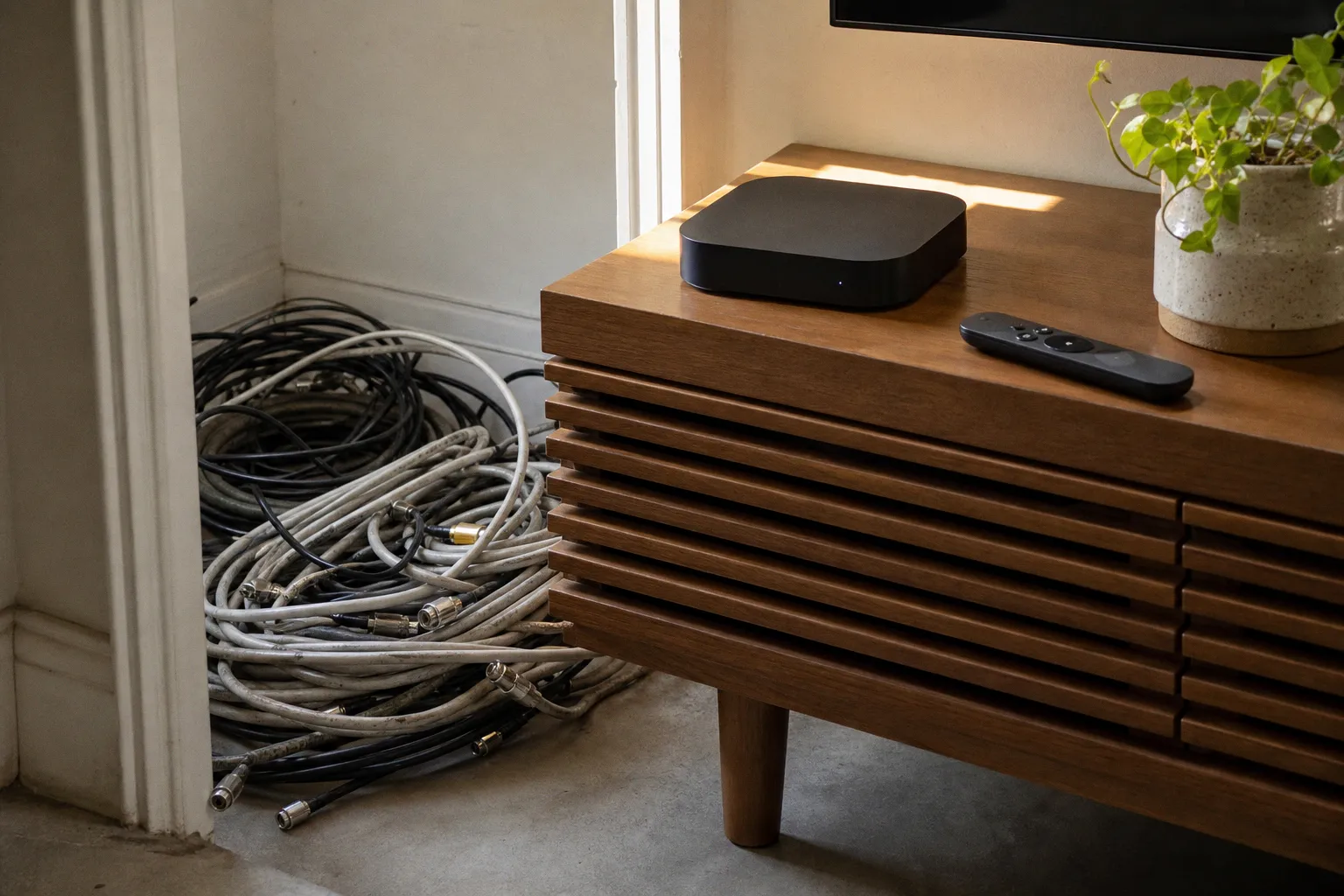
The practical question in 2026 is whether a service can reproduce the parts of cable a household actually uses—local affiliates, live sports, news, DVR access, and a stable set of entertainment networks—without replacing one opaque bill with several others.
The market has moved decisively in that direction. Streaming represented 47.5% of total U.S. television viewing in December 2025, while traditional cable accounted for 20%. That does not mean every streaming bundle is automatically a cheaper or cleaner replacement. It means the center of gravity has shifted: programming rights, affiliate negotiations, regional sports fees, and advertising inventory are increasingly being managed through internet-delivered TV packages.
For this comparison, the relevant services are YouTube TV, Hulu + Live TV, Fubo, Sling TV, and an antenna-supported setup. The assessment is not based on headline price alone. It weighs the parts of a cable replacement that tend to fail at the moment viewers need them: local channel availability, sports access, carriage-dispute exposure, mandatory fees, and the limits of cloud DVR systems.
Streaming has surpassed cable, but it has inherited cable’s operating model
Cord-cutting began as a rejection of the large cable bundle. The current live-TV streaming market has largely rebuilt that bundle with a different delivery mechanism.
YouTube TV, Hulu + Live TV, and Fubo negotiate broad carriage agreements with national network groups, local station owners, sports leagues, and regional sports networks. Their channel lineups are therefore subject to the same commercial pressures that affect cable and satellite providers. A carriage dispute can remove a channel family without warning; a sports network can command a local surcharge; and a high-profile network group can use its portfolio as leverage during contract talks.
The difference is operational rather than philosophical. Streaming services offer month-to-month cancellation, more flexible device access, integrated cloud DVRs, and fewer installation requirements. Cable still has advantages in markets where broadband is unreliable, where promotional bundles remain competitive, or where a household requires a particular regional sports network that is unavailable through streaming.
That distinction matters because “cancel cable” is not a complete strategy. A household replacing a full cable package needs to identify which programming is truly non-negotiable:
- Local ABC, CBS, FOX, NBC, PBS, CW, and independent stations for network sports, election coverage, weather, and local news.
- ESPN, FS1, TNT, TBS, and league-specific channels for national sports windows.
- Regional sports networks for locally televised MLB, NBA, and NHL games where applicable.
- News channels and entertainment networks that may be spread across live bundles and standalone streaming subscriptions.
- A usable DVR, especially for viewers who follow network schedules rather than an entirely on-demand watchlist.
A service that covers four of those five needs is not necessarily a full cable replacement. It may still be the correct purchase, but it should be assessed as a deliberately narrower bundle.
Live TV streaming is cable’s successor, not its opposite: the delivery is different, while the rights negotiations remain very familiar.
Pricing: the advertised monthly rate is only the opening number
The price gap between cable and live TV streaming has narrowed substantially. YouTube TV’s base plan stands at about $83 per month after a $10 increase implemented in early 2026. Hulu + Live TV’s ad-supported offering is positioned around $89 per month and includes Disney+ and ESPN+ as part of the base bundle. Sling TV remains the low-cost entry point at roughly $46 per month, though it achieves that figure by offering a materially less complete local-channel package in most markets.
Fubo occupies a different position. It is designed around a sports-forward lineup, but its advertised price can exclude a mandatory regional sports network fee in applicable markets. That fee can add up to $15 per month. For viewers who chose Fubo specifically to watch local professional teams, this is not a minor add-on; it is part of the real monthly cost.
The comparison below reflects the practical structure of each service rather than a promotional headline.
| Service | Approximate base price | Local-channel position | Sports profile | Primary compromise |
|---|---|---|---|---|
| YouTube TV | $83/month | Broad local affiliate coverage in many markets | Strong national sports mix | Higher base price; subject to major carriage disputes |
| Hulu + Live TV | About $89/month | Broad local coverage in supported areas | Strong general sports and Disney ecosystem | Highest listed base cost among general-purpose options |
| Fubo | Varies by package and market | Locals available in many markets | Best fit for sports-first households | RSN fee can add up to $15/month; lineup gaps can matter |
| Sling TV | About $46/month | Limited major-network local availability in most markets | Useful selective sports option | Often requires an antenna to restore local coverage |
| Antenna + selective streaming | Hardware cost plus apps | Dependent on reception and market | Excellent for free broadcast events where receivable | Reception is location-specific; not a universal substitute |
The financially sound way to compare these services is to calculate the complete monthly viewing stack, not merely the live-TV subscription.
A household that keeps Netflix, adds a premium service for prestige drama, pays for a league package, subscribes to a live-TV bundle, and rents a compatible streaming device may end up at or above its former cable cost. The advantage is not guaranteed savings. It is the ability to choose which costs remain in the stack and to remove them when a season, league, or series cycle ends.
That control is meaningful, but it is not frictionless. Live TV streaming services have become more expensive because the content libraries and rights packages they carry have become more expensive. The economics of sports and local broadcasting do not disappear when the coaxial cable is removed.
The same convergence is visible beyond television. Platform operators increasingly combine music, podcasts, live events, video advertising, and subscription products into one audience strategy; LiveOne’s 2026 approach to music streaming, podcasts, and live-event integration is a useful adjacent example. For television viewers, the result is a marketplace where a “service” is less a channel provider than a bundle manager.
YouTube TV vs. Hulu Live: the general-purpose decision
For most households seeking a direct cable replacement, the practical comparison remains YouTube TV versus Hulu + Live TV. Both are broad bundles with local channels in many markets, national cable networks, sports programming, and cloud DVR functionality. Both retain recordings for up to nine months. Neither is positioned as a low-cost option.
YouTube TV is the cleaner choice for viewers who want a straightforward live-TV interface, wide device support, and a package that remains focused on the channel grid and DVR. Its base price of about $83 per month is not inexpensive, but it is comparatively transparent in a category where sports fees and bundle add-ons can obscure the final number.
Hulu + Live TV has a different value proposition. Its roughly $89 monthly ad-supported tier includes Disney+ and ESPN+, which can make the economics more favorable for households already paying for those services separately. The bundle also gives viewers a more direct route between live channels and Hulu’s on-demand library, though that integration matters more to heavy on-demand users than to viewers who primarily watch live news and scheduled sports.
The correct decision is therefore less about nominal price than existing subscriptions and viewing behavior:
1. Choose YouTube TV when the requirement is a broad live-TV replacement with minimal bundle complexity. It is particularly suitable for households that already manage their on-demand services separately and want the live component to remain distinct.
2. Choose Hulu + Live TV when Disney+, ESPN+, and Hulu’s on-demand catalog are already part of the household budget. The included services can reduce duplication, even though the live bundle itself carries a higher list price.
3. Treat both as vulnerable to carriage negotiations. Neither service owns the networks it distributes. A channel lineup is an active commercial agreement, not permanent infrastructure.
The last point is essential. In late 2025, a dispute between Disney and YouTube TV led to the temporary removal of Disney-owned channels, including ESPN, for roughly 10 million YouTube TV subscribers. The blackout demonstrated the weakness in any “one app replaces cable” assumption. A national sports event or a major network series can become unavailable not because of a technical failure, but because two companies have not agreed on wholesale distribution terms.
For viewers, the lesson is not that YouTube TV is uniquely unreliable. Traditional cable systems, satellite providers, and competing live-TV streamers all face the same risk. The lesson is that a household relying on a single live bundle should understand which channels would be most disruptive to lose for a week or two.
Sports is where the cheapest cable replacements stop being simple
Sports remains the pressure point in every cord-cutting calculation. National games are distributed across broadcast networks, ESPN, TNT, TBS, FS1, league-owned services, and increasingly platform-specific packages. Local games may depend on regional sports networks, which are often the most expensive and least stable element in a live-TV lineup.
Fubo is the strongest broad choice for sports-first viewers because its package architecture has historically prioritized sports channels and, in many markets, regional sports network access. Yet that access is precisely why its price structure needs close examination. The mandatory RSN fee, reaching as much as $15 per month in some markets, materially changes the advertised price.
A household following only national NFL games has different needs from one following a local baseball team through a full season. The first may be well served by a combination of antenna reception, a general live-TV service, and selective streaming subscriptions. The second needs to verify the exact local RSN situation before choosing a provider, because an otherwise excellent sports bundle may not carry the network that holds the local rights.
This is also the category most exposed to blackouts and shifting rights. A service can have an impressive national channel lineup while missing the one regional network that determines whether viewers can watch most local games. Conversely, a regional network can be present today and become a negotiation issue later.
The disciplined approach is to build the decision around the actual teams and events watched, not around the word “sports” in a service’s marketing copy:
- Identify whether the household needs national sports, local pro-team broadcasts, college conferences, international leagues, or all of the above.
- Check the service’s current channel lookup for the home ZIP code rather than relying on a national lineup page.
- Include RSN surcharges in the monthly calculation before comparing prices.
- Keep an antenna in the evaluation for major broadcast-network windows, particularly NFL, college football, and marquee events carried by local affiliates.
- Assume that no provider can guarantee permanent access to every channel family during a carriage negotiation.
A sports bundle is only complete if it carries the games a household actually watches in its own market.
Sling TV deserves a specific mention here. At about $46 per month, it remains one of the most credible cheap cable replacements for viewers willing to accept a selective lineup. It can be efficient for households that want certain cable networks and do not need a fully replicated traditional package. But it is not a drop-in cable substitute for most viewers because major local affiliates—ABC, CBS, FOX, and NBC—are absent in many markets. Sling makes more sense when paired with a reliable antenna, not when purchased under the assumption that every local network will be available in-app.
An antenna is now part of a modern streaming strategy—but not a universal answer
The strongest cord-cutting setups increasingly combine broadband-delivered television with over-the-air reception. An antenna can restore access to local broadcast stations without a monthly retransmission charge, and it can provide a useful fallback during disputes involving local affiliates or national network groups.
This is not nostalgia for pre-cable television. It is a practical response to how broadcast rights are distributed. Network football, local news, major award shows, election-night coverage, and many primetime programs remain available over the air in markets with viable reception.
ATSC 3.0, marketed as NextGen TV, now reaches more than 76% of U.S. households. The standard can offer improved transmission capabilities, but the consumer situation remains uneven. Many newer NextGen TV broadcasts use DRM encryption, and certain tuner arrangements may require an internet connection to obtain decryption authorization. Viewers should not assume that every ATSC 3.0 signal will behave like a simple free-to-air ATSC 1.0 channel.
The older ATSC 1.0 system also remains relevant. Its eventual sunset date is still under FCC review, so it should not be treated as an immediate discontinuity. For the current buying decision, the more immediate question is reception: distance from broadcast towers, terrain, building materials, elevation, and indoor interference determine whether an antenna is useful.
An antenna should be considered in three scenarios:
- Sling TV households: it can fill the local-network gap that the skinny bundle leaves in many markets.
- Sports viewers: it provides a no-monthly-fee path to local network broadcasts, assuming reception is adequate.
- Viewers seeking dispute resilience: it preserves access to local stations when an internet TV provider loses channels in a carriage conflict.
It should not be purchased on the assumption that every address can receive every local station. Dense urban construction, hills, distant towers, and apartment placement can produce sharply different outcomes within the same metropolitan area. Antenna reception is a location test, not a generic product promise.
The verdict: choose the bundle around failure points, not channel counts
The best cable TV alternatives depend less on which platform advertises the largest lineup than on which failure point a household can tolerate.
YouTube TV is the most balanced general cable replacement for viewers who want a broad live package, conventional channel navigation, local affiliates in supported markets, and a substantial cloud DVR. Its price now places it firmly in premium-bundle territory, and the Disney/ESPN blackout showed that its lineup remains exposed to high-stakes carriage disputes.
Hulu + Live TV is the better value where Disney+, ESPN+, and Hulu’s on-demand catalog are already recurring expenses. It is less compelling for a household that wants only live television and has no interest in the included streaming services.
Fubo is the leading option for viewers whose schedule is built around sports, but only after confirming the local channel lineup and calculating the RSN fee. It is a sports solution, not an automatic value solution.
Sling TV remains the disciplined low-cost choice, particularly for viewers who can pair it with an antenna and accept a narrower live-TV package. Without that antenna support, its limited local coverage makes it difficult to recommend as a full replacement for conventional cable.
The broader conclusion is less dramatic but more useful: cord-cutting now works best as a designed system. A live-TV service handles the channels that must be watched in real time; an antenna covers viable local broadcasts; and on-demand subscriptions rotate according to what the household is actually watching. That arrangement will not always produce the lowest bill, but it gives viewers more control over the bill—and over what disappears from it when the season ends.
FAQ
Is YouTube TV cheaper than traditional cable?
Why does Fubo cost more than its advertised price?
Is Sling TV a good replacement for full cable?
Should I choose YouTube TV or Hulu + Live TV?
Can I use an antenna to watch all my local channels?
 Cable & BroadcastingSelect the best satellite TV provider for rural sports
 Cable & BroadcastingATSC 3.0 Tuners: The Best NextGen TV Boxes for Any Budget
 Cable & BroadcastingATSC 3.0 tuner solutions for Plex, DVR, and PC setups
 Cord-Cutting & SubscriptionsDowngrade to Hulu with Ads to Save $10 a Month